Avoid preventable PLM implementation rework.
Get a practical guide for aligning scope, ownership, processes, data, integrations, and adoption before configuration decisions lock your team into avoidable complexity.
Inside the guide
- A phased framework from planning through stabilization
- Decision areas that commonly create implementation risk
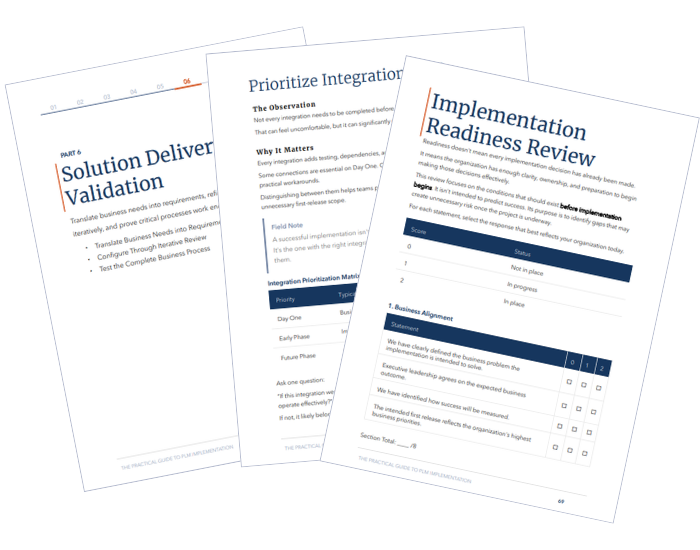
- A team-based PLM Implementation Readiness Review
- Guidance for sponsors, process owners, Engineering, Quality, IT, and Operations
Why implementation problems start early
Many PLM implementations encounter the same problem: the software gets the attention while critical business decisions are made too late.
When those decisions remain unresolved, teams often encounter avoidable rework, late-stage surprises, and added complexity during implementation.
The guide helps teams address these decisions deliberately, from initial planning through post-go-live improvement, rather than allowing software configuration to make the decisions for them.
Built around a simple principle:
Configuration should support decisions the business has made deliberately, not compensate for decisions it has avoided.
Built from the patterns experienced implementation teams learn to address early.
Implementation Guide
This guide captures the same phased approach we've used over and over with real customers.
FAQ
Who is this guide for?
The guide is designed for organizations preparing for a PLM implementation, whether you're implementing PLM for the first time, replacing a legacy platform, or preparing an existing PLM environment for future growth.
It is particularly useful for project sponsors, process owners, Engineering, Quality, IT, Operations, and other stakeholders who will participate in implementation decisions.
Is this a technical PLM implementation manual?
No. The guide intentionally starts outside the software.
Configuration, migration, and integrations matter, but many implementation problems originate earlier: unclear objectives, undefined ownership, inconsistent processes, poor data preparation, and insufficient organizational readiness.
The guide focuses on building that foundation so technical implementation decisions have clear business direction.
When should we use the guide?
Ideally, before implementation begins.
The early sections can help teams establish scope, ownership, governance, and priorities before configuration starts. Later sections can then be referenced during process design, data preparation, integration planning, adoption, go-live, and stabilization.
Think of it less like an instruction manual and more like a road map with checkpoints throughout the implementation.
What is the PLM Implementation Readiness Review?
The guide concludes with a practical assessment covering five areas:
- Business alignment
- Leadership and governance
- Process understanding
- Data and integration preparation
- Organizational readiness
Rather than producing a simple pass-or-fail score, the review helps identify areas where additional preparation may reduce unnecessary implementation risk.
Does the guide tell us exactly how our PLM system should be configured?
No, because configuration should follow the needs of the business rather than dictate them.
The guide helps teams clarify the objectives, processes, ownership, data requirements, integrations, and adoption needs that should inform configuration decisions.